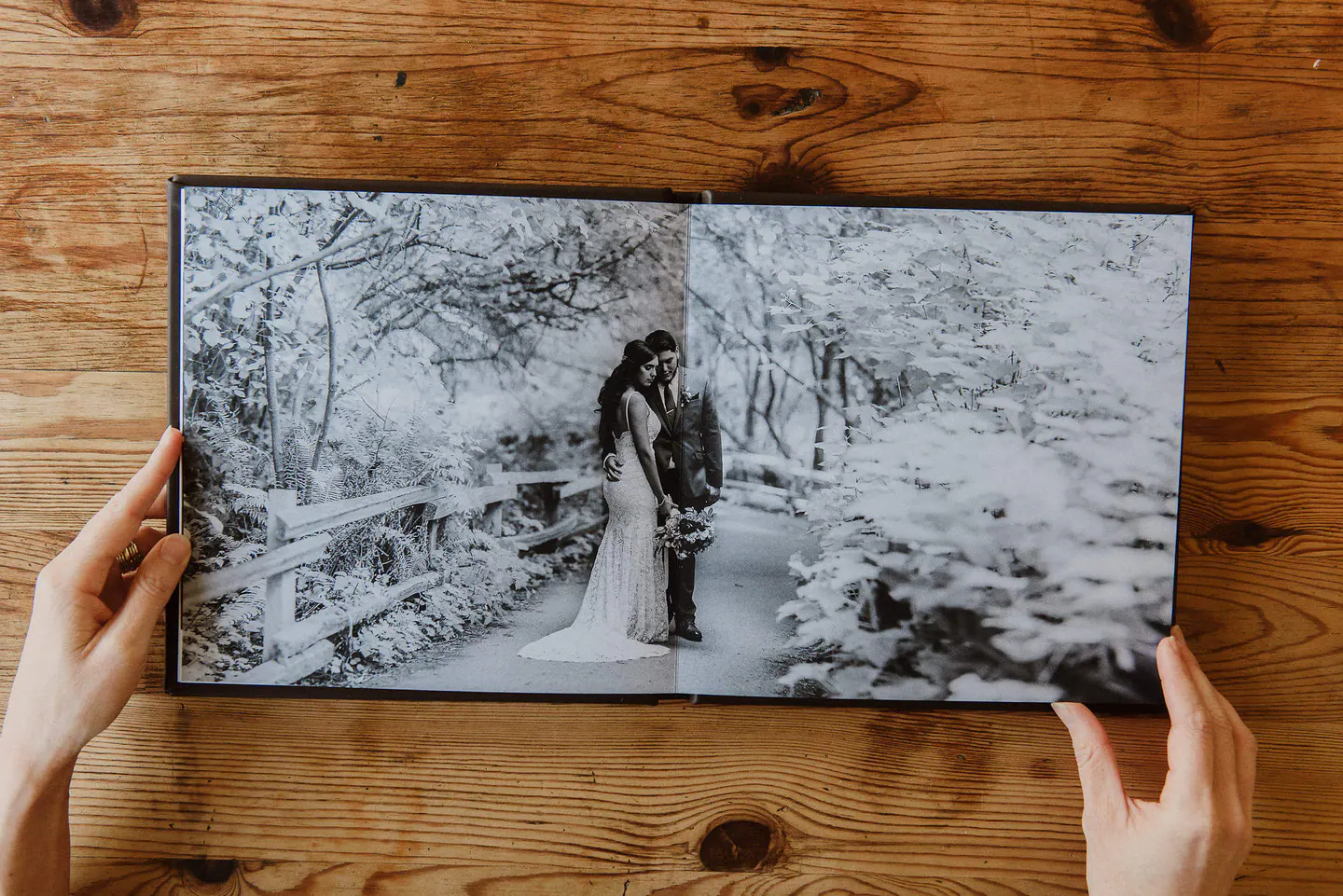

A gallery is the easiest way to receive, revisit, share, and order from a wedding story. It is not the permanent object itself. Digital services change, accounts lapse, devices fail, and files become harder to find when the next phone or computer arrives. A simple archive and a few physical photographs keep the work from becoming another link buried in an inbox.
This section explains the handoff from our protected working files to the couple’s long-term archive, what full-resolution files are, why syncing is not the same as backing up, how the print shop works, and why an album is useful even when every image remains available digitally.
A useful way to begin
Make one decision clearly, then let the next one follow.
Download the originals
The full-resolution files are the beginning of your archive.
Download every high-resolution file while the gallery is active and keep the delivered filenames intact. Open several files at full size before assuming the transfer is complete. Social downloads, screenshots, and files saved from messages are useful for sharing, but they are not the printable originals and should not become the only surviving copy of the wedding.
Keep independent copies
Syncing devices is convenient; versioned backup is protection.
Keep at least three copies, on two kinds of storage, with one copy off-site. A cloud service should retain earlier versions and deleted files rather than immediately mirroring every mistake. Protect the account with a unique password and multi-factor authentication. Label the archive clearly, verify that files open from each destination, and review it annually and before replacing a device.
Print what keeps returning
Begin with the photograph, not the product.
Choose the frames that produce a small daily jolt of recognition: a person’s expression, the weather, the crowded room, or the private joke that brings the experience back. Then decide whether the image belongs on a wall, in a small frame, inside a box, or as part of a sequence. Professional paper and finishing make the physical object easier to live with for a long time.
Keep the sequence
An album makes the complete story usable without a screen.
An album holds relationships between photographs: preparation next to the ceremony, reactions beside portraits, the quiet table before the room fills, and the ending after the obvious events. A thoughtful design does not need every delivered file. It needs enough range and pacing that somebody can understand what the wedding felt like without opening a folder or knowing which images were once posted online.
Go deeper when the question becomes specific
The library is organized around decisions, not content volume.

Receive and protect
Download, verify, and back up the complete gallery.
Separate the studio’s redundant working archive from the couple’s long-term responsibility after delivery, then use a straightforward three-copy system that can survive device failure, deletion, and account changes.

Understand the gallery
Know what arrives and what remains available.
Learn how many photographs a complete story may contain, why curation matters, how filenames and resolutions work, and why the gallery is designed for sharing and ordering rather than acting as the only archive.

Make something physical
Prints and albums return the photographs to everyday life.
Start with emotional importance, then choose scale, paper, frame, box, or album. The shop handles professional production; the album preserves the relationship between frames and the complete arc of the day.
The short version
A durable photographic handoff is simple enough to maintain.
- 01
Every full-resolution file downloaded while the gallery is active
- 02
At least three verified copies, including one versioned off-site backup
- 03
Clear filenames and folders that another family member could understand
- 04
A yearly check and another check before replacing computers, phones, or drives
- 05
At least one meaningful photograph—or the complete story—made physical
Complete afterward directory
Browse all 4 guides in this section.
Complete afterward directory
Browse all 4 guides in this section.
Use the information, then return to the experience
Planning should make it easier to be there.
If the guides have clarified the shape of what you need, tell us about the people, place, and part of the plan that is still uncertain. We can help from there.
Explore prints and the gallery system Tell us what you are planning